
Measured, not estimated
Sugargoo shipping lines, and how long they really take
Published by Sugargoo 25 August 2026 · covers 21 July to 21 August 2026
Sugargoo publishes measured delivery times for its main routes, broken into three ten day windows with a monthly average and a score out of 10. The figures below are read directly from that notice. They are signature times, so the clock stops when somebody signs for the parcel, not when it leaves China.
Two different clocks, do not mix them
The timeliness notice counts natural days to signature. The route specification tables elsewhere on the official site quote working days as a reference range. A route listed at 10 to 20 working days and a measured 14 day average are not in conflict, they are two ways of counting. Where they disagree, prefer the measured figure.
United States
Five routes measured. US Fast Line is both the quickest and the highest scored, at roughly half the time of the EMS option.
Windows shown are 21 to 31 July, 1 to 10 August and 11 to 21 August 2026. Source: Sugargoo official route timeliness notice, 25 August 2026.
Reading it: the two routes scored 10 are there for different reasons. US Fast Line wins on speed. US Tax Free wins because it bills on actual weight, which matters enormously for bulky items even though it takes six days longer.
United Kingdom
The UK is Sugargoo's strongest market on these numbers. Three routes land in a week or less.
Source: Sugargoo official route timeliness notice, 25 August 2026.
Reading it: UK Fast Line is tax inclusive, meaning the import charge is settled inside the shipping price. The Tax-Free variant bills on actual weight and takes four days longer. For a heavy flat parcel that trade is often worth making, and the cost page shows the arithmetic.
Germany, France and the EU
Two routes share the top score and both bill on actual weight. FR Fast Line is markedly quicker but is priced tax inclusive.
Source: Sugargoo official route timeliness notice, 25 August 2026.
EU import rules changed on 1 July 2026
The duty free exemption for parcels under EUR 150 has been removed. The replacement is charged per product category at a fixed EUR 3 per distinct HS code, and those charges accumulate, so grouping more of the same category into one parcel is now cheaper than spreading categories across it. Details on news.
Canada
Canada is measured as receipt time rather than signature time. Source: official notice, 25 August 2026.
Australia
The one market where the top scored route is not the fastest. Source: official notice, 25 August 2026.
The arithmetic nobody explains
Why the box matters more than the line
Shipping is billed on whichever is greater, the actual weight or the volumetric weight. Actual weight is the goods plus all packaging materials. Volumetric weight is length times width times height in centimetres, divided by a number the carrier sets.
That divisor is where people get caught. Sugargoo's help centre gives 5000 as the general figure and notes third party carriers may use 6000, 7000 or 8000. The published route specifications confirm it: EMS and the US Tax-Free line both calculate on 6000.
A higher divisor is better for you. The same 40 by 30 by 20 centimetre box is 4.8 kg volumetric at 5000 and 4.0 kg at 6000. If the goods themselves weigh 3 kg you are billed on the volumetric figure either way, and the gap between two lines can exceed the difference in their per kilo rate.
This is why routes marked Actual Weight score so well in the official list even when slower. For anything bulky and light, a padded jacket being the obvious case, they can be dramatically cheaper.
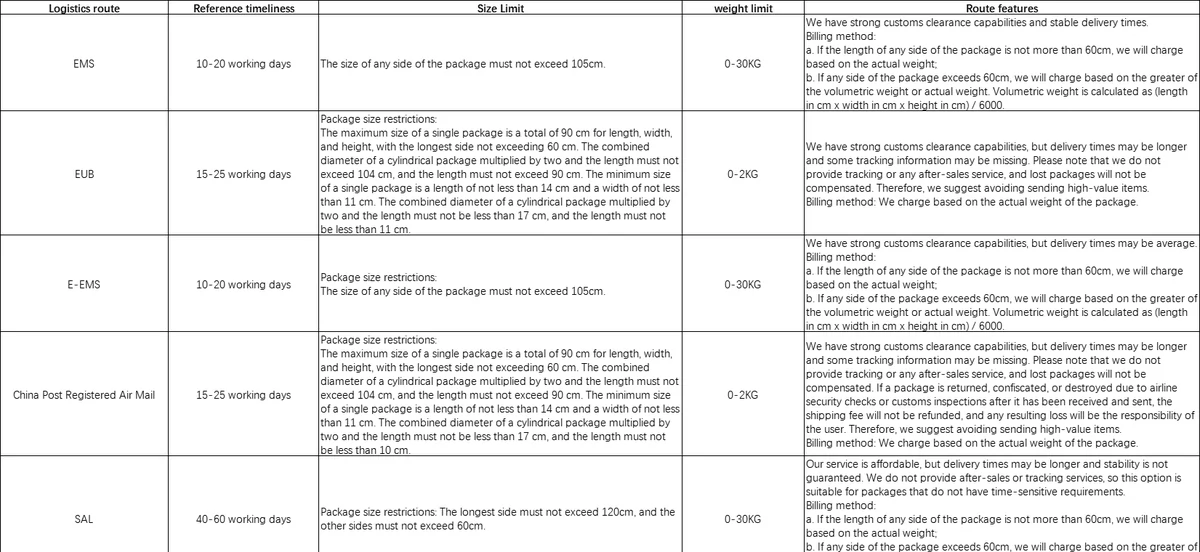
The official route specification table also sets size and weight ceilings per line. EUB caps at 2 kg, EMS at 30 kg. Read 27 August 2026.
How to choose a route
Work through these in order. Which route wins depends on your parcel, not on a league table.
Rule out anything your parcel cannot use
Weight and size ceilings come first. EUB and China Post Registered Air Mail cap at 2 kg, which excludes most shoe orders immediately. EMS and E-EMS go to 30 kg. Several lines refuse any side longer than 60 cm.
Decide whether you are bulky or dense
Run the volumetric sum on your expected box. If volumetric weight beats actual weight, prioritise a line billed on actual weight. If your parcel is small and heavy that distinction does not matter, so optimise for speed instead.
Choose who handles the tax
Tax inclusive lines such as UK Fast Line and FR Fast Line settle the import charge inside the shipping price, so nothing is demanded at your door. Tax free lines are cheaper up front but leave you exposed to whatever your customs decide. Neither is automatically better, they suit different appetites for surprise.
Only now compare the days
Speed is the last filter, not the first, because a fast line your parcel is too heavy for is not an option at all. Within the routes that survive steps one to three, the measured averages above are the fairest guide available.
One route type to treat with caution
The official specification for EUB states plainly that it provides no after sales service, that lost parcels are not compensated, and that tracking information may be missing. SAL is cheaper still but quotes 40 to 60 working days. Both are reasonable for something you can afford to lose and are in no hurry for. Neither is where you send an expensive order.